Chronology of the Works
of Fyodor Dostoevsky
The complete published work of Fyodor Dostoevsky, ordered by the date of its first appearance, framed by the documented biographical events around it.
From Debut to the Scaffold
Fifteen works in five years, all published in Saint Petersburg magazines. The run is cut short by the April 1849 arrest.
- 1821
Birth of Fyodor Dostoevsky
Fyodor Mikhailovich Dostoevsky is born in Moscow on 30 October 1821 —11 November in the Gregorian calendar— in the staff wing of the Mariinsky Hospital for the Poor, where his father, the physician Mikhail Andreevich, had served since that same year. He is the second child of the marriage to Maria Fyodorovna Nechaeva; the eldest, Mikhail, his future publishing partner, had been born in 1820.
Dates: born 30 October 1821 (11 November Gregorian), Moscow, Mariinsky Hospital.
- Feb 1837
- Jan 1838
Move to Saint Petersburg and Admission to the Academy of Military Engineers
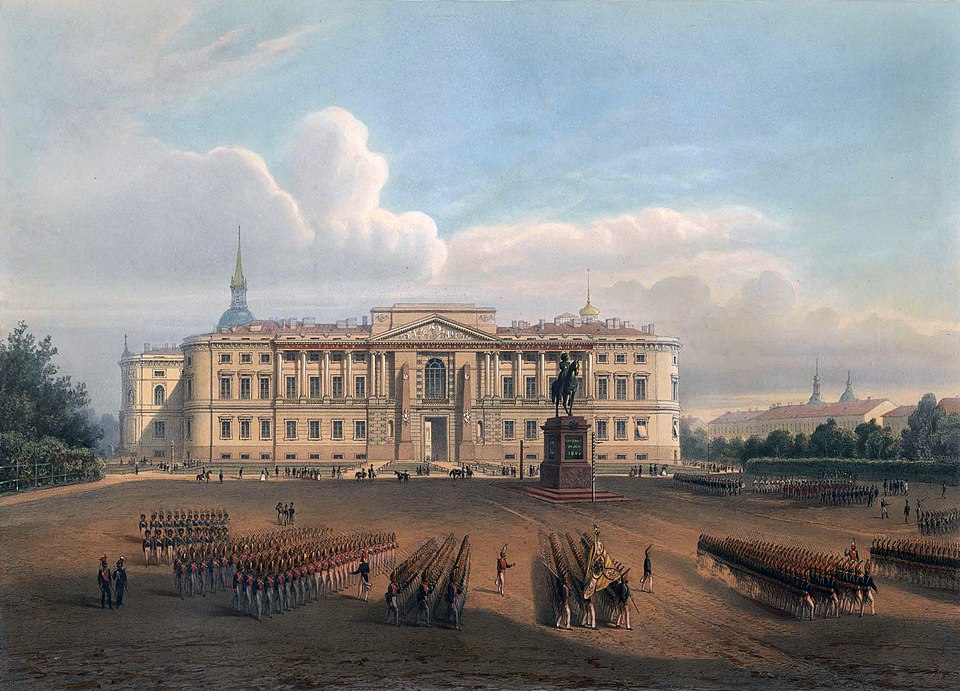
The Engineers' Castle in Saint Petersburg, home to the Academy of Military Engineers that Dostoevsky entered in January 1838.Period lithograph · Wikimedia Commons, public domain In May 1837, three months after his mother's death, their father takes Mikhail and Fyodor to Saint Petersburg to prepare them at Captain Kostomarov's boarding school.
Fyodor is admitted to the Academy of Military Engineers on 16 January 1838, housed in the Engineers' Castle, the former palace of Paul I.
Academy of Military Engineers: admitted 16 January 1838; graduated August 1843, posted to the Saint Petersburg Engineering Directorate.
- Jun 1839
Death of His Father
- 1844
01Eugénie Grandet
Balzac's novel follows Eugénie, the daughter of a wealthy and miserly provincial landowner, whose life changes when a ruined cousin comes to live with the family and she falls in love with him. A translation of Honoré de Balzac's novel. It is the first text of Dostoevsky's to reach print. He translated it in late 1843, and it appeared the following year in the magazine Repertoire and Pantheon, without the translator's name being given.
He translated it while still a serving engineering officer: that same year he requested his discharge from the army to live by literature (see the next entry).
Publication: Repertoire and Pantheon, 1844, unsigned.
- Oct 1844
Resignation from the Army to Live by Writing
In September 1844 Dostoevsky submits his request to retire from the Corps of Engineers; it is granted on 19 October, with the rank of lieutenant. He was twenty-two, had no book of his own published, and had only an anonymous translation to his name.
The decision is deliberate: he gives up a secure salary to devote himself to writing. Fifteen months later, Poor Folk would appear.
Dates: request, September 1844 · discharge granted, 19 October 1844.
- Jan 1846
02Poor Folk
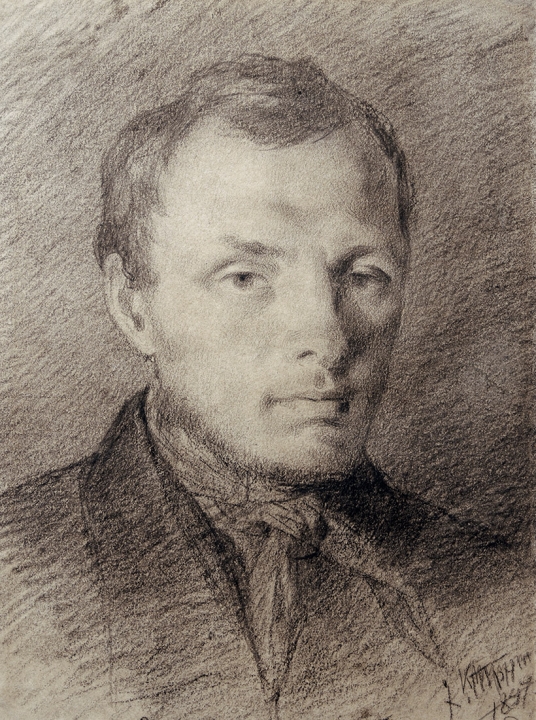
Dostoevsky in 1847, at twenty-five, shortly after the success of his first novel.Drawing by Konstantin Trutovsky, 1847 · Wikimedia Commons, public domain Told through letters between an aging clerk and a young seamstress related to him, it captures the hardship and wounded pride of poverty in Petersburg. An epistolary novel, his first published work of his own. It appeared on 21 January 1846 in the almanac The Petersburg Collection, edited by Nekrasov, with the generic subtitle “a novel” supplied by the author himself. The manuscript had circulated in late May 1845 among Grigorovich, Nekrasov, and the critic Belinsky, so Dostoevsky's name was already known in the capital's literary circles before the novel reached print.
Publication: the almanac Petersburgsky Sbornik, 21 January 1846.
- 1846
03The Double
It narrates the gradual mental breakdown of the clerk Golyadkin, haunted by a man identical to him who begins to take his place at the office and in his social life. Published on 1 February 1846 in issue no. 2 of Notes of the Fatherland, Krayevsky's magazine, a few weeks after Poor Folk, with the subtitle “The Adventures of Mr. Golyadkin.” The 30 January date given by the English Wikipedia does not match the Russian bibliographic description.
Dostoevsky returned to the text twenty years later: the shortened, rewritten 1866 version is the one usually translated, though some current editions publish both.
Publication: Notes of the Fatherland, 1846, no. 2, appeared 1 February. Second version: 1866.
- Oct 1846
04Mr. Prokharchin
It portrays a withdrawn, miserably-living petty clerk who keeps a small hoard of savings secret, and whose fear of ruin and dismissal drives him to an extreme of miserliness. Published in issue no. 10 of Notes of the Fatherland. It is the third text Dostoevsky publishes within a year, and the second in a row to be poorly received by Belinsky's circle, though the author himself wrote to his brother Mikhail on 17 October 1846 that “Prokharchin is being greatly praised.”
Publication: Notes of the Fatherland, 1846, no. 10.
- Jan 1847
05A Novel in Nine Letters
An epistolary satire between two business partners, Pyotr Ivanovich and Ivan Petrovich, whose letters, each seemingly more cordial than the last, gradually let slip the vanity and pettiness of both men. A tale told through an exchange of letters. It is the only early work that did not appear in Notes of the Fatherland: it came out in issue no. 1 of The Contemporary, in January 1847, in the very first issue of the period when the magazine passed into the hands of Nekrasov and Ivan Panaev.
Publication: The Contemporary (Sovremennik), 1847, no. 1.
- Apr–Jun 1847
06Petersburg Chronicle
These are journalistic sketches, ironic and observant in tone, about everyday life and the social types of the Russian capital. Four Sunday feuilletons published in the newspaper St. Petersburg Gazette under the signature “F. D.”: 27 April (no. 93), 11 May (no. 104), 1 June (no. 121), and 15 June (no. 133) of 1847. It is the author's first work of journalistic prose.
The attribution was not evident at the time: it was established by the researcher V. S. Nechaeva, who gathered and republished the texts in 1922, and A. S. Dolinin added the no. 121 piece in 1927. There is also a fifth feuilleton, from 13 April (no. 81), signed “N. N.,” which some scholars attribute to Dostoevsky in collaboration with A. N. Pleshcheyev; being doubtful, it is not counted among the four.
Publication: Sankt-Peterburgskie Vedomosti, 1847, nos. 93, 104, 121, and 133.
- Oct–Dec 1847
07The Landlady
It tells of the fascination of the young, solitary scholar Ordynov with Katerina, a woman under the sway of the enigmatic Murin, in a tale with gothic, dreamlike overtones. Finished on 9 September 1847 and published in two installments in Notes of the Fatherland: the first part in volume LIV, no. 10, pages 396–424; the second in volume LV, no. 12, pages 381–414. The English Wikipedia gives October and November, but cross-checking against the Russian bibliographic description confirms issues 10 and 12. The first standalone edition was brought out by Stellovsky in 1865.
Murin, the character who dominates the heroine, is the first of Dostoevsky's epileptic characters, a condition the author himself suffered from and would not receive a formal diagnosis of until a decade later.
Publication: Notes of the Fatherland, 1847, vol. LIV no. 10 (pp. 396–424) and vol. LV no. 12 (pp. 381–414). First standalone edition: 1865, Stellovsky.
- Jan 1848
08Another Man's Wife
A comedy of errors: a man convinced his wife is deceiving him chases a stranger through the nighttime streets of Petersburg, mistaking him for the lover he is looking for. Published in issue no. 1 of Notes of the Fatherland with the subtitle “A Street Scene.” In 1860 Dostoevsky merged it with “A Jealous Husband” into a single piece, which is the form in which it now circulates (see entry 19).
Publication: Notes of the Fatherland, 1848, no. 1.
- Feb 1848
09A Weak Heart
It tells of the mounting anguish of Vasya Shumkov, a young clerk newly engaged to be married, who is overwhelmed by the fear of not finishing an assignment from his superior in time. Published in issue no. 2 of Notes of the Fatherland.
Publication: Notes of the Fatherland, 1848, no. 2.
- Apr 1848
10An Honest Thief
A narrator remembers Emelyan, a drunken but good-hearted lodger who one day, to get money for vodka, stole a garment that was not his and could never forgive himself for it. It did not appear under this title. It was published in issue no. 4 of Notes of the Fatherland as part of a set called “Stories of an Experienced Man (From the Notes of an Unknown Person),” whose first chapter was “The Retired Man” and the second, “An Honest Thief.”
When he republished it, Dostoevsky cut the first chapter almost entirely and gave the whole set the title of the second. That is the version that gets translated.
Publication: Notes of the Fatherland, 1848, no. 4.
- 1848
11Polzunkov
It portrays a minor clerk who makes a fool of himself in front of the other guests at a dinner to earn himself a place at the table, in a monologue as comic as it is bitter about voluntary humiliation. A singular case: it was printed but barely circulated. Dostoevsky handed it to the editorial office of The Contemporary in early December 1847 for the “Illustrated Almanac” that Ivan Panaev and Nekrasov were editing, announced under the provisional title “Plismylkov's Tale.” The text also passed through an intermediate title, “The Buffoon,” recorded in a letter from the editors to the censorship committee dated 7 December 1848. The almanac was actually printed with the story already titled “Polzunkov,” but its distribution was blocked by the tightened censorship that followed the European revolutions of 1848, and only a few copies survived.
On 14 December 1848 the censorship committee authorized the editors to prepare a replacement volume, the “Literary Compendium,” with permission to include the story among its texts. But when the volume came out in March 1849, “Polzunkov” was no longer in it: the commentators of the academic edition attribute the omission to the deteriorating relationship between Dostoevsky and the magazine.
Publication: “Illustrated Almanac,” 1848; edition withdrawn by the censor. The usual bibliographic date is 1848; some sources date it to 1847, when the manuscript was submitted, and others to 1883, the year the story actually reached readers, in the posthumous complete works.
- Sep 1848
12A Christmas Tree and a Wedding
A narrator recalls a children's Christmas party at which an adult guest coldly, unsettlingly calculates the future advantages of courting a wealthy little girl present at the gathering. Published in issue no. 9 of Notes of the Fatherland.
Publication: Notes of the Fatherland, 1848, no. 9.
- Dec 1848
13White Nights
A solitary dreamer in Petersburg strikes up, over four nights of conversation, an intense friendship with Nastenka, a young woman awaiting the return of another man. Published in issue no. 12 of Notes of the Fatherland with the subtitle “A Sentimental Novel (From the Memoirs of a Dreamer).” Dostoevsky revised the text for the 1860 edition of his works.
Publication: Notes of the Fatherland, 1848, no. 12. Revision: 1860.
- Dec 1848
14A Jealous Husband
This is another satirical variation on marital jealousy, in the same comic vein as “Another Man's Wife,” with which Dostoevsky would merge it two years later. Published in the same issue no. 12 of Notes of the Fatherland as White Nights. Two years later it was reworked and joined to “Another Man's Wife” under a shared title, and since then it has rarely been published on its own.
Publication: Notes of the Fatherland, 1848, no. 12.
- Jan–May 1849
15Netochka Nezvanova
An unfinished novel narrated by an orphan girl who recalls a childhood marked by the resentment of her stepfather, a frustrated musician, and her later life in an aristocratic household. It began appearing in issues 1 and 2 of Notes of the Fatherland for 1849. The May installment appeared without the author's name, since by then he was under arrest. Publication broke off there, and the novel was left unfinished.
Dostoevsky never continued it, but he did return to it. In preparing the 1860 edition of his works, and now taking it for granted that there would be no continuation, he turned the opening of that intended large novel into a self-contained novella: he removed the division into three parts —“Childhood,” “New Life,” and “The Secret”— numbered the chapters, and cut the episodes that introduced characters meant for a plot that would now never be written. That is the version read today.
Publication: Notes of the Fatherland, 1849, nos. 1–2 and 5. Revision: 1860, recast as a novella.
- Apr–Dec 1849
Arrest, Death Sentence, and Mock Execution
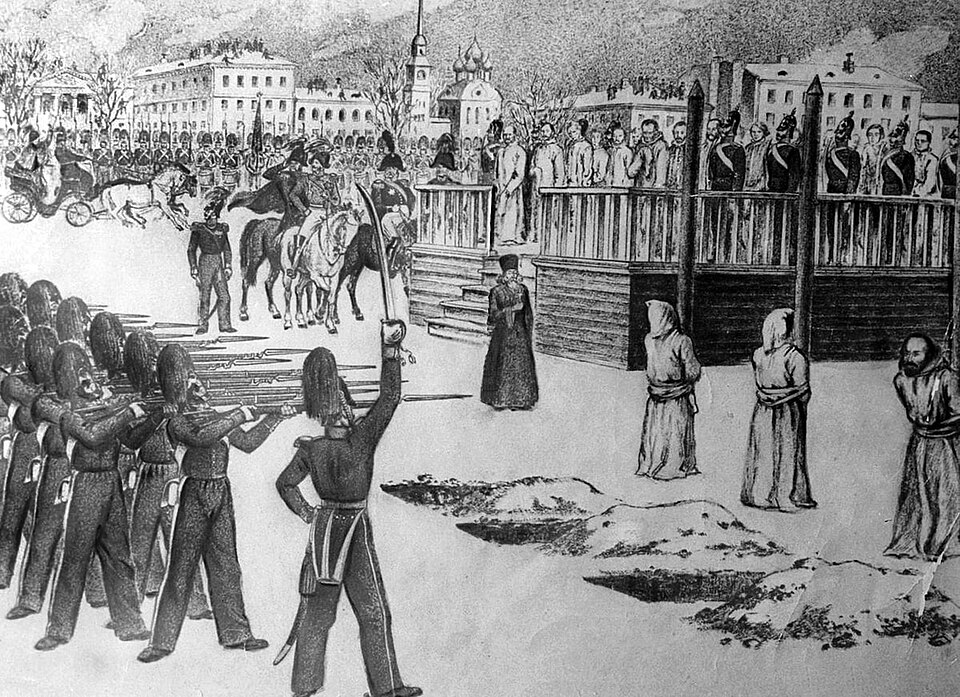
The mock execution on Semenovsky Square, 22 December 1849. The first three condemned men, already bound to the posts and hooded, await the volley that never came.Drawing by B. Pokrovsky · Wikimedia Commons, public domain At four in the morning on 23 April 1849, Dostoevsky is arrested along with other members of the Petrashevsky Circle —a discussion group of young men in Saint Petersburg who read and debated the French utopian socialists, banned by the censor— and locked in cell no. 9 of the Alekseevsky Ravelin, inside the Peter and Paul Fortress. The number arrested that night is not firmly established: the figure most often repeated in Russian sources is 36, but Grossman gives 34, and other accounts speak of around 30 or 33. Across the whole case file, those implicated came to about forty.
In November the military commission hands down a death sentence by firing squad. Nicholas I approves the commutation —four years of hard labor followed by service as a private soldier— with the express instruction that the reprieve be announced “only at the moment when everything is ready for the execution.”
On 22 December 1849 the condemned men are led out onto Semenovsky Square. The execution is halted at the last instant, and the rescript of pardon is read out. Two days later Dostoevsky sets off in chains for Siberia.
Dates: arrest 23 April 1849 · sentencing November 1849 · mock execution 22 December 1849.
Siberia and the Years of the Journals
Eight years without publishing anything, a gradual return, and the period in which Dostoevsky runs, together with his brother Mikhail, two magazines of their own that censorship and debt eventually shut down.
- 1850–1854
Penal Servitude in Omsk
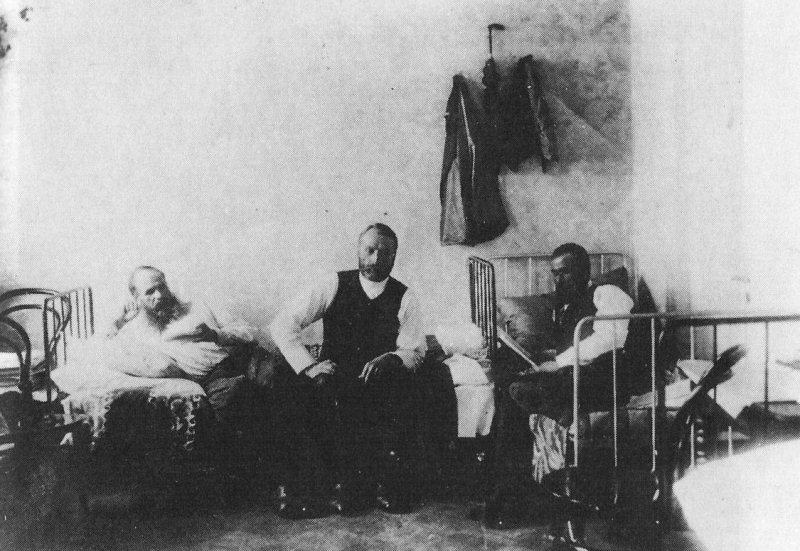
Interior of a barracks in the Siberian prison camp.Period photograph · Wikimedia Commons, public domain On the way to Siberia, on 9 January 1850, the convicts pass through Tobolsk, where the wives of the Decembrists —the officers who had risen up against Nicholas I in 1825, whose wives voluntarily followed them into exile— visit them at the transit prison. Joseph Frank names three: Muravyeva, Annenkova, and Natalya Fonvizina. Each gave him a copy of the Gospels with ten rubles hidden in the binding. It was the only book prison regulations allowed him to keep over the next four years; he kept it for the rest of his life.
On 23 January 1850 he enters the Omsk fortress. The various release dates found in different sources describe distinct steps, and all three are correct: the four-year sentence is completed on 23 January 1854, but he remains imprisoned until 15 February, and for health reasons is allowed to stay in Omsk a further month before joining, in March, the Seventh Siberian Line Battalion in Semipalatinsk as a private soldier. Throughout this period he publishes nothing. What survives from his time there is a notebook of 486 entries, known today as the Siberian Notebook.
Dates: entered 23 January 1850 · sentence completed 23 January 1854 · released from the camp 15 February 1854 · joined the battalion, March 1854.
- 1857
Marriage, Epilepsy Diagnosis, and Restoration of Civil Rights
Posted as a soldier in Semipalatinsk from February 1854, Dostoevsky meets, that same year, the official Alexander Isaev and his wife, Maria Dmitrievna, who would become his first wife. Isaev dies in August 1855. On 6 February 1857 Dostoevsky marries her in Kuznetsk; on the return journey he suffers a seizure that a doctor diagnoses, this time unambiguously, as epilepsy. Until then he himself had been unsure: “strange attacks, which resemble epilepsy and yet are not epilepsy,” he had written to his brother.
On 17 April 1857 an imperial decree restores his hereditary nobility. It is this act that, in practice, restores his right to publish. The general amnesty for the petrashevtsy —as members of the circle were called in Russian— had been announced on the day of Alexander II's coronation, 26 August 1856, along with the simultaneous order to keep the writer under secret police surveillance.
Dates: wedding 6 February 1857 · restoration of noble status 17 April 1857.
- Aug 1857
16A Little Hero
An eleven-year-old boy, during a stay at a country house, experiences his first infatuation and a test of courage in front of the adults around him. Written in 1849 in his cell at the Peter and Paul Fortress, between the end of the interrogation and the sentencing, under the provisional title “A Children's Tale.” It was published eight years later, in August 1857, in issue no. 8 of Notes of the Fatherland, without Dostoevsky's authorship being indicated: his brother Mikhail handled the submission, and the text appeared signed with the pseudonym “M-y” (М-ий in the original).
Written: 1849, Peter and Paul Fortress. Publication: Notes of the Fatherland, 1857, no. 8, unsigned by the author.
- Mar 1859
17Uncle's Dream
A provincial comedy in which an ambitious mother tries to marry her daughter off to a wealthy, decrepit old prince visiting the town. The first work Dostoevsky publishes under his own name after ten years of silence. It came out in issue no. 3 of The Russian Word in March 1859. Together with Stepanchikovo, it did not get the critical reception the author had hoped for, and that disappointment weighed on his later decision to make his real comeback with Notes from the House of the Dead.
Publication: The Russian Word, 1859, no. 3.
- Nov–Dec 1859
18The Village of Stepanchikovo and Its Inhabitants
A comedy about the strange relationship between the good-hearted Colonel Rostanev and Foma Opiskin, the tyrannical houseguest who dominates his household morally. Published in issues 11 and 12 of Notes of the Fatherland, at the end of 1859. The character of Foma Opiskin is the most elaborate comic creation of the period.
Publication: Notes of the Fatherland, 1859, nos. 11 and 12.
- Dec 1859
Return to Saint Petersburg
On 18 March 1859 Dostoevsky obtains his discharge from the army with the rank of second lieutenant, under secret police surveillance and required to live outside the two capitals; he chooses Tver, where he arrives on 19 August and sees his brother Mikhail again after ten years.
Permission to live in Saint Petersburg arrives on 2 December; at the end of the month, on the 20th, he settles in the capital with his family. This closes a decade without a work published under his own name.
Dates: discharge 18 March 1859 · permission granted 2 December 1859 · arrival 20 December 1859.
- 1860
19Another Man's Wife and the Husband Under the Bed
A nighttime comedy of errors about a jealous husband who, chasing a supposed lover of his wife, ends up hiding under a stranger's bed. A reworking of the two 1848 stories (entries 8 and 14) into a single piece, with the subtitle “An Extraordinary Event.” It appeared in the two-volume edition of his works published in 1860. It is the canonical version and the only one usually translated.
Publication: Works of F. M. Dostoevsky, 2 vols., 1860.
- Sep 1860 – 1862
20Notes from the House of the Dead
Its publication happened in two stages, which is why bibliographies give different dates. The “Introduction” and first chapter appeared on 1 September 1860 in no. 67 of the newspaper Russian World; the series continued there in 1861, in issues 1 (4 January), 3 (11 January), and 7 (25 January). After that the text started over from the beginning in the magazine Time, where it was published in full between 1861 and 1862.
The work is narrated by a fictional character, a nobleman convicted of murdering his wife. Attributing the account to an invented convict, rather than to himself, was the condition for the censor to let a direct description of the penal system through: a political convict could not publish his own testimony, but a work of fiction about an ordinary criminal could be printed.
Publication: Russian World, 1860, no. 67 · 1861, nos. 1, 3, and 7 · Time (Vremya), 1861, nos. 4 and 9–11 · 1862, nos. 1–3, 5, and 12.
- Jan 1861
21The Insulted and Injured
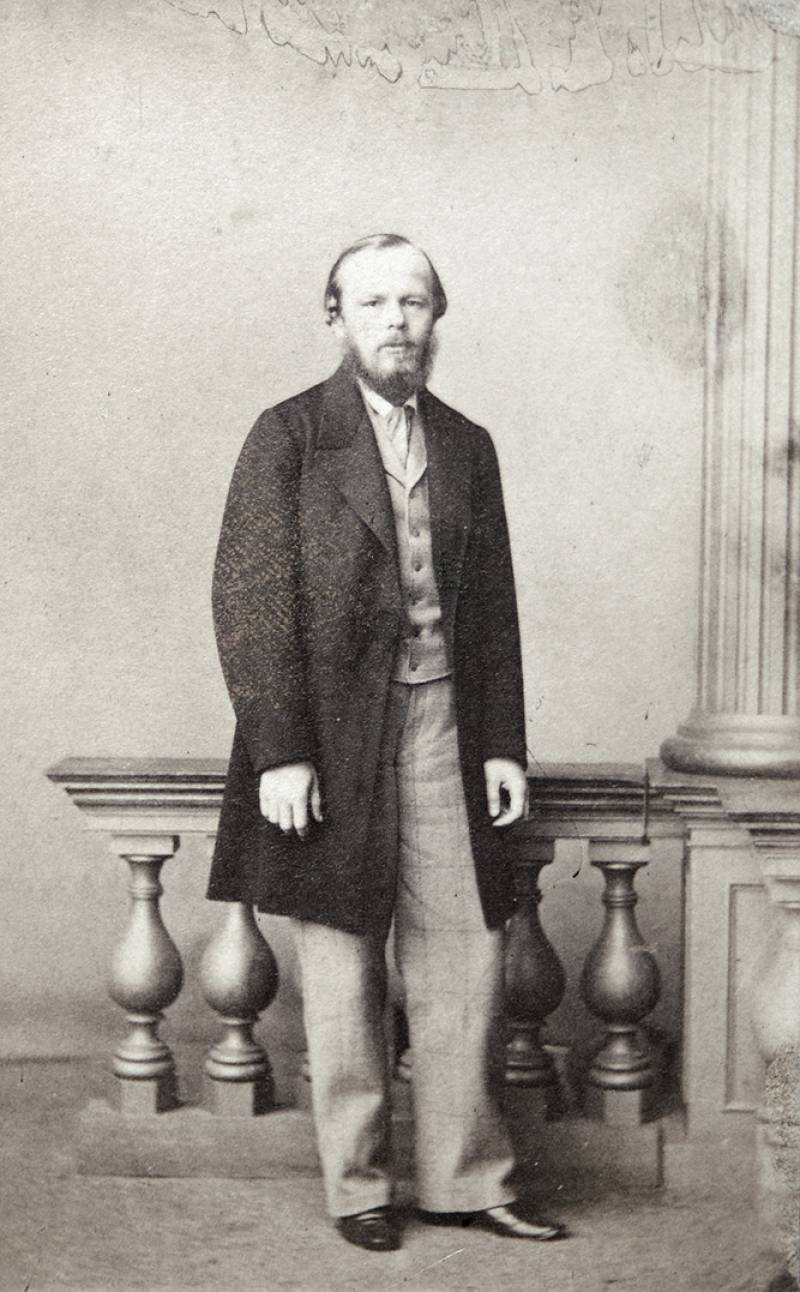
Dostoevsky in 1861, the year this novel appears and Time, the brothers' magazine, begins.Photograph by M. B. Tulinov, 1861 · Wikimedia Commons, public domain Two storylines intertwine: the writer Ivan Petrovich, Natasha's former fiancé, stays close to her after the young woman leaves her family for Alyosha, son of the wealthy Prince Valkovsky; and the girl Nelly, who carries a dark family secret, enters Ivan's life almost by chance.
Publication: Time (Vremya), 1861, vol. I, no. 1, pp. 5–92, and subsequent issues.
- Feb 1861
22Mr. —bov and the Question of Art
Published unsigned in issue no. 2 of Time for 1861, as part of the series “Articles on Russian Literature,” whose introduction had appeared in the January issue. The “—bov” in the title is the ending of the surname of Nikolai Dobrolyubov, named this way by a convention of the press of the time for polemicizing against someone without writing out their full name. In the article, Dostoevsky attacks Dobrolyubov's utilitarian aesthetics —which judged art by its social or political usefulness— and argues that the work of art has a value of its own, independent of any practical purpose.
A surviving draft shows that the article was first called “Mr. —bov and Artistic Quality,” under the general title “Literary Oddities.”
Publication: Time (Vremya), 1861, no. 2, unsigned.
- 1862
23A Nasty Story
After drinking too much and proclaiming to his colleagues a humane philosophy toward his subordinates, the senior official Ivan Ilyich Pralinsky decides to put it to the test by showing up unannounced at the wedding of one of them. Published in issue no. 11 of Time for 1862, pages 299 to 352, signed “Fyodor Dostoevsky.” The story is set against the backdrop of the liberal reforms of the early 1860s.
Publication: Time (Vremya), 1862, no. 11, pp. 299–352.
- Feb–Mar 1863
24Winter Notes on Summer Impressions
Published in issues 2 and 3 of Time for 1863. It draws on Dostoevsky's first trip abroad, begun on 7 June 1862, in which he visited more than twenty cities across Western Europe —Berlin, Dresden, Cologne, Paris, London, Florence, Turin, Geneva, Vienna— over two and a half months.
Publication: Time (Vremya), 1863, nos. 2 and 3. Journey recounted: June–September 1862.
- May 1863
Banning of the Journal Time
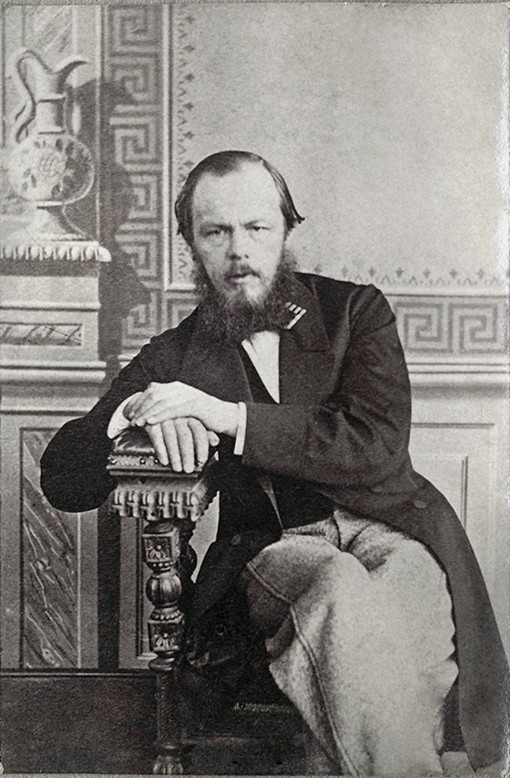
Dostoevsky around 1863, the year an imperial order shuts down Time.Period photograph · Wikimedia Commons, public domain On 24 May 1863 an imperial order bans Time over the article “The Fatal Question,” by Nikolai Strakhov, about that year's Polish uprising. The piece was read as pro-Polish. The magazine had financially supported the two brothers for two and a half years.
Between August and October 1863 Dostoevsky makes his second trip to Europe, with Berlin, Wiesbaden, Paris, Baden-Baden, Turin, Genoa, Rome, Naples, Livorno, Homburg, and Dresden on the itinerary.
That trip also brings the other debt that will haunt him for a decade: it is at the roulette tables of the German spa towns that gambling becomes a compulsion for him. He would return to them on every trip abroad until 1871.
Date: banning order, 24 May 1863.
- Mar–Apr 1864
25Notes from Underground
It is the confession of an anonymous, resentful, and isolated narrator who challenges the rationalist optimism of his age and revisits the humiliations of his own life, among them his dealings with the young Liza. Published in Epoch, the magazine Mikhail Dostoevsky obtained authorization to edit on 24 January 1864, after Time was banned. The first part came out in the combined January–February issue, which appeared in March 1864; the second, in the April issue.
Publication: Epoch (Epokha), 1864, nos. 1–2 (March) and no. 4 (April).
- Apr · Jul 1864
Death of Maria Isayeva and Mikhail Dostoevsky
On 15 April 1864 Maria Dmitrievna, the writer's first wife, dies of tuberculosis in Moscow.
On 10 July 1864 Mikhail Mikhailovich Dostoevsky, his elder brother and publishing partner, dies at the age of 43. According to the English Wikipedia, he collapsed on 19 July by the Gregorian calendar —the 7th by the Julian— after learning that the censor had rejected an important article, and died three days later.
Fyodor is left in charge of Epoch and voluntarily takes on his brother's debts, along with the support of the widow, her four children, and his own stepson.
Dates: Maria Isaeva, 15 April 1864 · Mikhail Dostoevsky, 10 July 1864 (22 July Gregorian).
- Mar 1865
26The Crocodile
A fantastical satire about the official Ivan Matveich, swallowed alive by a crocodile on display in a shopping arcade, who from inside the animal takes advantage of his new situation to hold forth on grand ideas. Its full title is “The Crocodile: An Extraordinary Event, or A Passage in the Arcade.” It appeared on 22 March 1865 in issue no. 2 of Epoch, which turned out to be the magazine's last issue: publication was never resumed. In all, Epoch put out thirteen issues.
The story was left unfinished. Some critics read it as an attack on Nikolai Chernyshevsky, then imprisoned, a reading Dostoevsky rejected.
Publication: Epoch (Epokha), 1865, no. 2, appeared 22 March 1865. Unfinished.
- Jul 1865
The Contract with Stellovsky: The Debt That Produced Two Novels
In July 1865, hounded by creditors after Epoch closed, Dostoevsky signs a contract with the publisher Fyodor Stellovsky for 3,000 rubles that hands over the rights to his already-written works and further requires him to deliver a new novel before 1 November 1866. If he failed to do so, Stellovsky would be entitled to publish all of his future work for nine years without paying him anything.
Out of that pressure come, at the same time, the two 1866 works. With the money from the contract he sets off for Europe after 16 July 1865, and on 29 July he begins Crime and Punishment, which he will sell in installments to The Russian Messenger throughout 1866. The novel he owed Stellovsky, meanwhile, he kept putting off until only a month was left: that is The Gambler, dictated over twenty-six days in October 1866. The two appear in this chronology as separate entries because they are different works, but they were born of the same contract.
Dates: contract, July 1865 · departure for Europe, after 16 July 1865 · Crime and Punishment begun, 29 July 1865 · deadline for the novel owed to Stellovsky, 1 November 1866.
The Great Novels
Fifteen years in which the five major novels appear, along with A Writer's Diary and the late stories published within it.
- Jan–Dec 1866
27Crime and Punishment
It follows the moral torment of Raskolnikov, an impoverished former student in Petersburg, after he commits a murder guided by his own theory about “extraordinary” men. Published in installments throughout 1866 in The Russian Messenger. It was not one installment a month: it appeared in eight issues, with gaps, nos. 1, 2, 4, 6, 7, 8, 11, and 12. The book edition appeared in 1867.
Dostoevsky had begun writing it on 29 July 1865 in Europe. In late November of that year he burned what he had written and started over. On 3 November 1866, with The Gambler now finished, he asked Anna Snitkina to take down the last part of this novel in shorthand as well.
Publication: The Russian Messenger (Russky Vestnik), 1866, nos. 1, 2, 4, 6–8, 11, and 12 (eight installments). Book edition: 1867.
- 1866
28The Gambler
Narrated by Alexei Ivanovich, tutor to the family of a ruined Russian general at a German spa town, it portrays roulette fever and his passion for Polina, the general's stepdaughter. Written against the clock to meet the deadline of the contract with Stellovsky, which fell due on 1 November 1866 and which Dostoevsky had kept postponing while publishing Crime and Punishment. On 4 October 1866 the twenty-year-old stenographer Anna Grigorievna Snitkina arrived at his home, and dictation began that same day. The two dates that circulate for its completion do not contradict each other: they describe different steps. The dictation ended on 29 October; on the 30th, the writer's birthday, Anna brought him the fair copy of the manuscript; on the 31st he made the final corrections. The traditional figure of twenty-six days of work comes from counting those days.
Dostoevsky asked Anna Snitkina to marry him on 8 November 1866. They married on 15 February 1867.
Publication: 1866, within Stellovsky's edition of his works. Dictated: 4 to 29 October 1866 · corrections on the 31st · contract deadline, 1 November.
- 1867
Marriage to Anna Snitkina and Departure for Europe
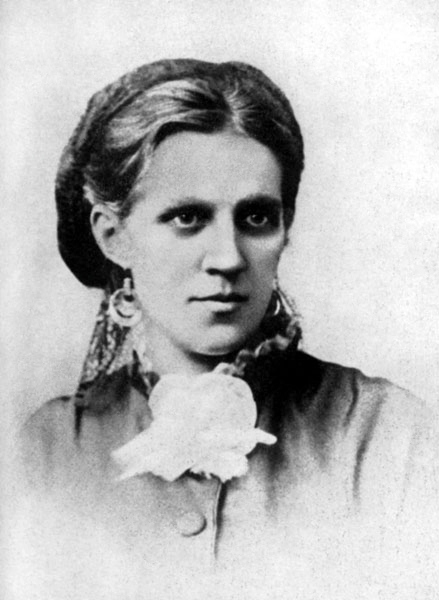
Anna Grigorievna Snitkina, stenographer for The Gambler and, from February 1867, the writer's wife. She managed his finances and his literary output until his death.Period photograph · Wikimedia Commons, public domain The wedding takes place on 15 February 1867 at Trinity Cathedral in Saint Petersburg. On 14 April the couple leaves the country, as planned, for a few months. The stay lasted more than four years, split between Berlin, Dresden, Baden-Baden, Basel, Geneva, Vevey, Milan, and Florence.
Dates: wedding 15 February 1867 · departure 14 April 1867 · length of stay, four years and three months.
- 1868–1869
29The Idiot
Prince Myshkin, a man of almost naive goodness newly arrived in Russia, becomes caught up in the loves and rivalries of Petersburg society, in particular with Nastasya Filippovna, also contested by the merchant Rogozhin. Publication began in issue no. 1 of The Russian Messenger for January 1868. Dostoevsky had committed to delivering the opening before he had worked out the plan of the novel, and he wrote it entirely outside Russia, between Geneva, Vevey, Milan, and Florence. He finished writing it in January 1869.
The way the series closed explains why bibliographies disagree: the conclusion came out in two pieces. Only three chapters of the final section made it into the December 1868 issue; the rest was printed separately, as a supplement, already in 1869. That is why Grossman dates the ending to December 1868, while Agón and the Universal Compendium record a 1869 installment: both halves are real.
Publication: The Russian Messenger (Russky Vestnik), from January 1868. Writing finished: January 1869.
- Feb–May 1868
Birth and Death of Sofia
Sofia, the couple's first daughter, is born in Geneva on 22 February 1868 and dies on 12 May of the same year, at three months old. Since the birth took place in Switzerland, the equivalence is worth giving: 22 February Julian is 5 March Gregorian, which is the date given by Joseph Frank and any Geneva civil record. The family leaves Geneva shortly afterward and moves to Italy.
Dates: born 22 February 1868 (5 March Gregorian) · died 12 May 1868 (24 May Gregorian).
- Sep 1869
Birth of His Daughter Lyubov
- Jan–Feb 1870
- 1871–1872
31Demons
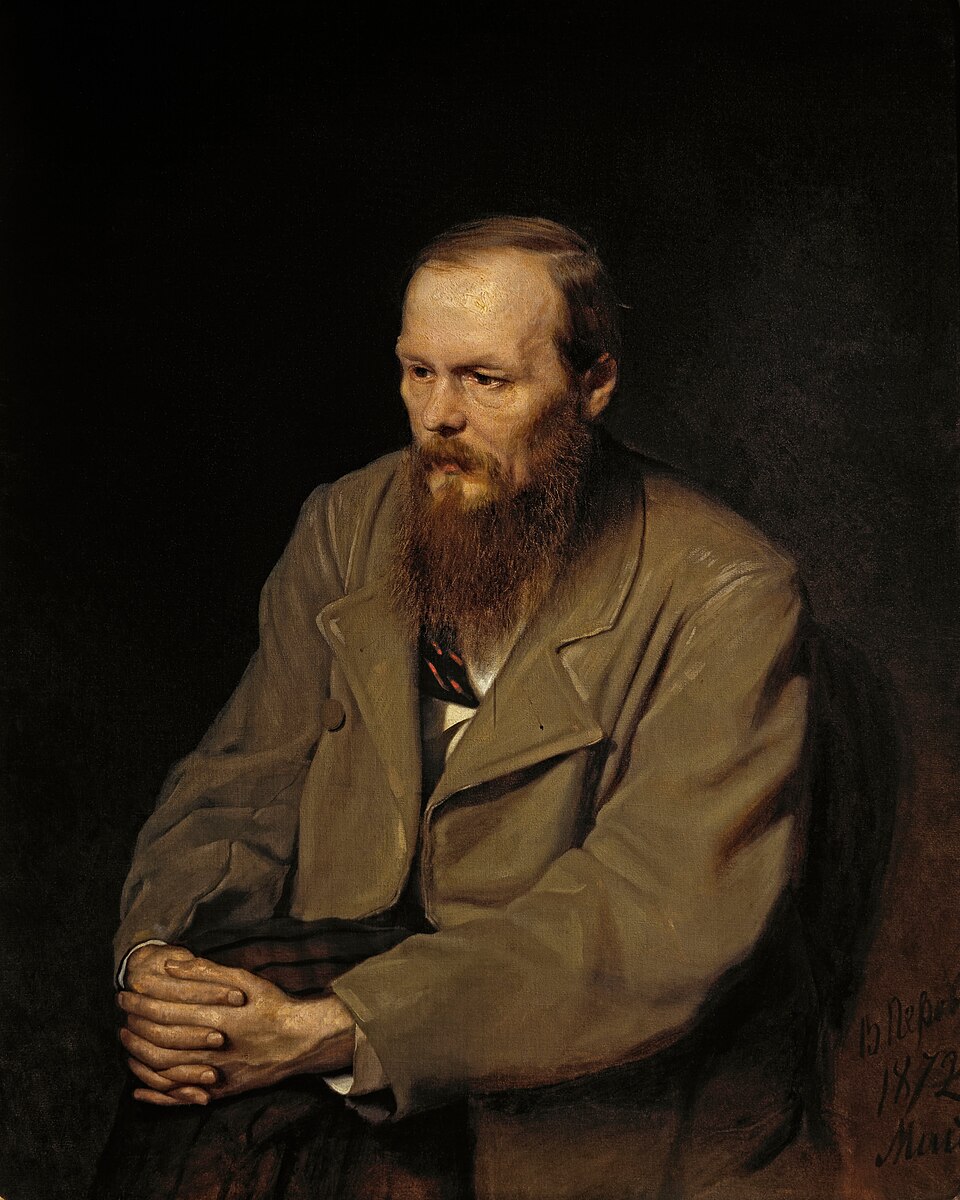
The canonical portrait, commissioned by Tretyakov while Dostoevsky was finishing this novel.Vasily Perov, oil on canvas, 1872 · Tretyakov Gallery · Wikimedia Commons, public domain The plot follows the revolutionary conspiracy that Pyotr Verkhovensky organizes in a provincial town around the enigmatic figure of Stavrogin. It began appearing in January 1871 in The Russian Messenger and ended in issues 11 and 12 of 1872. Its documented starting point is a real event: in November 1869, in Moscow, the revolutionary Sergei Nechaev and four companions murdered the student Ivanov, who had broken away from the group.
The serial publication went out without the chapter “At Tikhon's,” the written confession Stavrogin brings to the monk Tikhon about a dark episode from his past. Katkov, the editor of The Russian Messenger, refused to print it because of its rawness. Dostoevsky tried rewriting it and could not get it accepted; the chapter was never published in the author's lifetime and was also left out of the 1873 book edition, put out by the publishing house the Dostoevskys set up on their own. It was printed for the first time in 1922 (see entry 42).
Publication: The Russian Messenger (Russky Vestnik), January 1871 – nos. 11–12 of 1872, without the chapter “At Tikhon's.” Book edition: 1873.
- 1871
End of His Gambling and Return to Russia
In April 1871 Dostoevsky travels alone to Wiesbaden and loses at roulette again. In a letter to his wife dated 16 April —28 April by the Gregorian calendar— he announces that the compulsion that had dominated him since the trips of the early 1860s is over. The city of Wiesbaden's urban lexicon dates that letter to 28 April 1871. He never gambled again.
In July, before crossing the border and fearing that Russian customs would confiscate his papers, he burns his working notebooks: the drafts and preparatory notes for The Idiot, The Eternal Husband, and Demons. He is not destroying published work —all three novels had already appeared or were already appearing in installments— but the unpublished material they had grown out of. He leaves Dresden on 5 July and arrives in Saint Petersburg on 8 July 1871.
Dates: Wiesbaden letter, 16 April 1871 (28 April Gregorian) · arrival in Saint Petersburg, 8 July 1871.
- Jul 1871
- 1873–1881
32A Writer's Diary
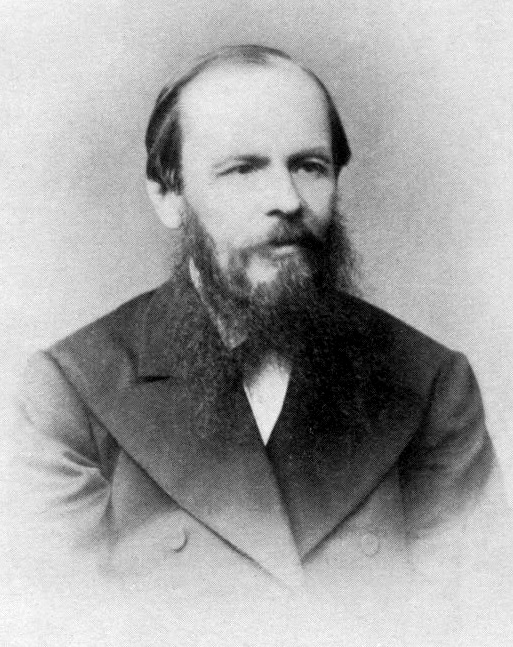
Dostoevsky in 1876, the year the Diary becomes his own magazine, written and financed by him alone.Period photograph · Wikimedia Commons, public domain It is a miscellany of chronicles, short stories, and reflections on current Russian political, social, and literary affairs, the work of Dostoevsky himself from start to finish and through both of its stages, with no other contributors.
In late December 1875 he obtained authorization to publish it as his own magazine, written and financed by him alone. The January 1876 issue was printed in 2,000 copies and sold out in two days, forcing an additional print run; the February issue came out with 6,000. Publication was suspended while he was writing The Brothers Karamazov.
In total, twenty-three issues were published as an independent magazine: eleven in 1876, ten in 1877, one in 1880, and one in 1881, this last one posthumous, appearing on 31 January 1881, three days after the author's death. It brings together court reporting, political articles, literary criticism, memoirs, and works of fiction; the five stories in entries 33 and 35 through 38 appeared within it.
Publication: The Citizen (Grazhdanin), 1873, sixteen installments · his own magazine, 1876, 1877, 1880, and 1881, twenty-three issues.
- 1873
33Bobok
Ivan Ivanovich, a writer down on his luck, lingers around a cemetery after a funeral and begins to hear the conversations of the dead, whose pettiness survives the grave itself. Published in February 1873 within A Writer's Diary, in the sixth installment of the series that appeared in The Citizen that year.
Publication: The Citizen (Grazhdanin), February 1873, sixth installment of A Writer's Diary.
- Jan–Dec 1875
34The Adolescent
Arkady Dolgoruky, the illegitimate son of the once-wealthy aristocrat Versilov, arrives in Petersburg obsessed with a scheme of his own for getting rich, and is drawn into the secrets and conflicts of his father's family. Dostoevsky began working on it in February 1874. It was published in installments throughout 1875, from January to December, in Notes of the Fatherland, the magazine edited by Nekrasov, rather than in The Russian Messenger, where his previous novels had appeared.
Publication: Notes of the Fatherland, 1875, January to December, with the subtitle “Notes of a Young Man.”
- Aug 1875
- Jan 1876
35The Beggar Boy at Christ's Christmas Tree
Published in the January 1876 issue of A Writer's Diary, the first of its run as an independent magazine. An abandoned, hungry child, alone in the street on Christmas Eve, finds comfort in the vision of a heavenly Christmas tree, lit for all the orphans of the world. The story grows out of two scenes Dostoevsky witnessed a few days apart: on 26 December 1875 he took his daughter Lyubov to a children's ball with a Christmas tree at the Saint Petersburg artists' club, and around those same days he was walking the capital's frozen streets gathering material for the issue, where he noticed a child begging.
The story quickly entered the canon of Russian children's reading: the following year Avenarius included it in the anthology “Thirty of the Best New Stories,” and in 1882 in “Exemplary Russian Stories.”
Publication: A Writer's Diary, January 1876.
- Feb 1876
- Nov 1876
37A Gentle Creature
Published in the November 1876 issue of A Writer's Diary, with the subtitle “A Fantastic Story.” It is written as a first-person monologue: a newly widowed man tries to piece together, beside the body of his young wife, the story of their marriage.
Its documented starting point is a news item Dostoevsky read in April 1876 about the suicide of a seamstress, an event he discussed in the Diary itself and referred to as a “meek suicide.”
Publication: A Writer's Diary, November 1876.
- Apr 1877
38The Dream of a Ridiculous Man
A philosophical, fantastical tale narrated by a man who, on the point of taking his own life, dreams of a utopian world before the Fall and wakes up transformed by what he has seen there. Published in the April 1877 issue of A Writer's Diary, also with the subtitle “A Fantastic Story.”
Publication: A Writer's Diary, April 1877.
- 1878
Death of Alexei and Journey to Optina Pustyn
Alexei, born on 10 August 1875, suffered his first epileptic seizure on 30 April 1878, lasting four minutes. On 16 May he had a seizure that lasted twelve hours and forty minutes and ended in his death. He was three years old. The Saint Petersburg museum's chronology gives 6 May, but Joseph Frank, his canonical biographer, the chronology based on Grossman, and the Znanie Rossii encyclopedia all agree on the 16th; the discrepancy cannot come from a calendar conversion, since in 1878 the gap between the Julian and Gregorian calendars was twelve days.
Still shattered by Alyosha's death, in June 1878 Dostoevsky travels to the monastery of Optina Pustyn: it was his wife, Anna, who convinced him to make that long-postponed trip, in the company of the philosopher Vladimir Solovyev, who was already visiting the monastery regularly. There he meets three times with Father Ambrose, whose words of comfort reappear almost verbatim in the mouth of Father Zosima as he consoles a grieving peasant woman in The Brothers Karamazov, the novel Dostoevsky was working on at the time. His son's death kept him from attending the International Literary Congress in Paris of May–June 1878, chaired by Victor Hugo, to which he had been invited in March to lead the Russian delegation.
On 3 October 1878 the family moves into the apartment at 5 Kuznechny Lane, where the writer would live until his death and where the F. M. Dostoevsky Literary-Memorial Museum, the first of this page's sources, now stands.
Dates: Alexei's birth, 10 August 1875 · first seizure, 30 April 1878 · death, 16 May 1878 (the museum gives the 6th) · journey to Optina Pustyn, June 1878.
- 1879–1880
39The Brothers Karamazov
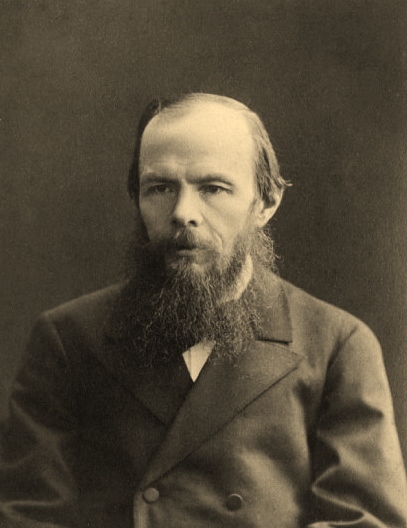
Dostoevsky in 1879, while publishing his last novel in installments.Period photograph · Wikimedia Commons, public domain It follows the three Karamazov brothers —Dmitri, Ivan, and Alyosha— and their fraught relationship with their father, the dissolute Fyodor Pavlovich, in a novel that probes faith, doubt, and family guilt. Published in installments in The Russian Messenger from January 1879 to November 1880. Dostoevsky finished it on 8 November 1880.
According to his own plans, the novel was the first of two parts; the second was to take place thirteen years later and was never written.
Publication: The Russian Messenger (Russky Vestnik), January 1879 – November 1880. Finished: 8 November 1880.
- Jun 1880
40The Pushkin Speech
Delivered on 8 June 1880 —20 June by the Gregorian calendar— in Moscow, during the celebrations for the unveiling of the Pushkin monument, which ran from 5 to 8 June. The speech was given at the second session of the Society of Lovers of Russian Literature, in the hall of the Assembly of the Nobility, two days after the monument's unveiling ceremony.
Dostoevsky published it with his own introduction in the August 1880 issue of A Writer's Diary. In the speech he had argued that Pushkin's gift for embodying the spirit of other peoples —unique, in his view, among great writers— prefigured Russia's mission: to be a brother to all peoples, a “pan-human” nation. The publication set off a press controversy over that idea that ran on for months.
Delivered: 8 June 1880, Moscow. Published: A Writer's Diary, August 1880.
- Jan–Feb 1881
Death and Funeral
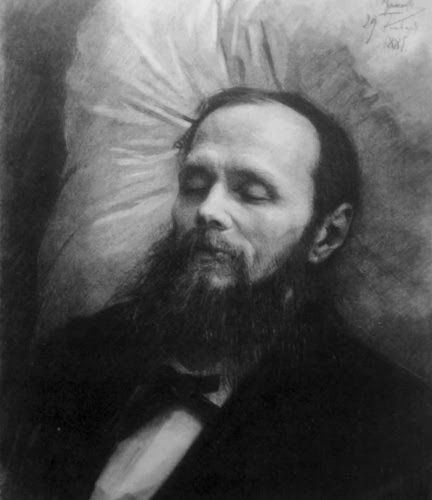
Dostoevsky on his deathbed, drawn from life a few hours after he died, on 28 January 1881.Ivan Kramskoi, 1881 · Wikimedia Commons, public domain In the first days of January 1881 Dostoevsky begins preparing the January issue of A Writer's Diary. On 26 January he suffers a hemorrhage from the throat; doctors diagnose a ruptured pulmonary artery. He dies on the evening of 28 January 1881 —9 February by the Gregorian calendar. The Saint Petersburg museum puts the time at 8:36 p.m.; Grossman's chronology, at 8:38 p.m.
The January issue of the Diary appeared on 31 January, three days later. The burial took place on 1 February at the Tikhvin Cemetery of the Alexander Nevsky Monastery, near Zhukovsky's grave. By imperial order, the widow and children received an annual pension of 2,000 rubles.
Dates: hemorrhage 26 January 1881 · death 28 January 1881 · burial 1 February 1881.
What Was Published Later
Two works Dostoevsky wrote and never saw in print: occasional verses he never submitted, and the chapter his own editor's censorship tore out of a novel.
- 1883
41The Three Poems from Semipalatinsk
Written during his exile as a soldier: “On the European Events of 1854,” “On the First of July, 1855,” and “On the Coronation and the Conclusion of Peace,” from 1856. They are occasional patriotic verses, written partly in hopes of having his right to publish restored; the second was forwarded through military channels to the Minister of War with the request that it reach the dowager empress.
None was printed in the author's lifetime. The first, on the events of 1854, was not published until 1883, in the literary supplement of the magazine The Citizen; the other two remained unpublished until twentieth-century academic editions. They are the only instance of verse in his entire body of work and, given their courtly tone, the piece most unlike anything else he wrote.
Written: 1854, 1855, and 1856, in Semipalatinsk. First published: 1883 (“On the European Events of 1854,” in The Citizen); the other two, in later academic editions whose exact year could not be confirmed.
- 1922
42At Tikhon's
The ninth chapter of the second part of Demons, in which Stavrogin brings the monk Tikhon a written confession about a dark episode from his past. Katkov refused to publish it in The Russian Messenger because of its rawness, and Dostoevsky could not get any rewrite accepted, so the novel appeared without it, both in installments and in book form.
It was printed for the first time in 1922, forty-one years after the author's death, by the Central Archive of the Russian Republic. Today most editions include it, either as a chapter or as an appendix, and its exact place in the novel is still debated.
Written: 1871–1872. First published: 1922, Moscow, Central Archive of the RSFSR.
Notes on This Chronology
What Is Left Out, and Why
The timeline covers everything Dostoevsky published as a work, in his lifetime or after. Left out is whatever is not a published work, and it is worth saying what that is:
- “How Dangerous It Is to Indulge Ambitious Dreams” (1846), a text in prose and verse written jointly with Nekrasov —the principal author— and Grigorovich, which appeared on 1 April 1846 in the almanac “April Fool's Day.” It was published in his lifetime, but it is not his work alone, and for that reason carries no number.
- The letters, more than seven hundred of which survive, written between 1832 and 1881.
- The working notebooks and the Siberian Notebook, a collection of 486 notes on popular speech taken during his imprisonment in Omsk.
- The abandoned projects, among them “The Life of a Great Sinner” (1869–1870), whose material was later distributed among several novels.
- The individual articles of A Writer's Diary, which number more than two hundred and are counted within entry 32, not one by one. Only the five fiction pieces that appeared in its pages are numbered separately.
Where the Sources Disagree
An honest chronology has to show where its sources disagree. These are the discrepancies that remain open after cross-checking against the academic edition and against Joseph Frank; the ones already resolved are explained in the relevant entry and have been removed from this list.
- Polzunkov: dated either 1848 —the printing date of the almanac withdrawn by the censor— or 1847, when Dostoevsky submitted the manuscript. This chronology uses 1848.
- A Little Hero: appears dated either 1849, the year it was written in the fortress, or 1857, the year of publication. This chronology uses 1857, the general criterion followed here.
- Notes from the House of the Dead: appears as 1860, 1861, or 1862 depending on which of the two serial publications is taken as the first. This chronology uses 1860, the initial appearance in Russian World.
- Number arrested on 23 April 1849: the figure most often repeated is 36; Grossman gives 34, and other accounts speak of around 30 or 33. There is no established figure.
Sources
The abbreviations at the foot of each entry point to this list. Russian sources were given priority for their closeness to the academic edition of the complete works; English- and Spanish-language sources were used for cross-checking and for translated titles.
- MDF. M. Dostoevsky Literary-Memorial Museum, Saint Petersburg — “Chronology of the Life and Work.” The official chronology of the museum housed in the writer's last home. https://www.md.spb.ru/dostoevskij/biografiya/
- RHRussian Historical Library — “Dostoevsky: A Chronology of His Life and Works.” A table based on L. P. Grossman's “Materials for a Biography of F. M. Dostoevsky (Dates and Documents),” published in the Collected Works in Ten Volumes, Moscow, 1956–1958. https://rushist.com/index.php/literary-articles/3927-dostoevskij-khronologiya-zhizni-i-proizvedenij
- RVB·SAE. I. Kiyko, commentary on “A Nasty Story,” in the Collected Works in Fifteen Volumes, Leningrad, Nauka. Reproduced at the Russian Virtual Library. https://rvb.ru/dostoevski/02comm/22.htm
- RVB·BOVV. A. Tunimanov, commentary on “Mr. —bov and the Question of Art,” in the same academic edition. https://rvb.ru/dostoevski/02comm/76.htm
- PSSCommentary to volume 2 of the Collected Works (Institute of Russian Literature, Pushkin House), on the publishing history of “Polzunkov” and the “Illustrated Almanac.” http://az.lib.ru/d/dostoewskij_f_m/text_0730.shtml
- WR·FMDRussian Wikipedia — “Достоевский, Фёдор Михайлович.” https://ru.wikipedia.org/wiki/Достоевский,_Фёдор_Михайлович
- WR·BIBRussian Wikipedia — “Библиография Достоевского.” https://ru.wikipedia.org/wiki/Библиография_Фёдора_Достоевского
- WR·PLRussian Wikipedia — “Петербургская летопись,” with the exact issue numbers and dates of the four 1847 feuilletons. https://ru.wikipedia.org/wiki/Петербургская_летопись
- WR·PZRussian Wikipedia — “Ползунков,” on the censorship of the “Illustrated Almanac.” https://ru.wikipedia.org/wiki/Ползунков
- ZRZnanie Rossii — an online Russian encyclopedia, entry on Dostoevsky; date of Alexei's death. https://znanierussia.ru/articles/Достоевский,_Фёдор_Михайлович
- WE·BIBEnglish Wikipedia — “Fyodor Dostoevsky bibliography.” https://en.wikipedia.org/wiki/Fyodor_Dostoevsky_bibliography
- WE·PFEnglish Wikipedia — “Poor Folk.” https://en.wikipedia.org/wiki/Poor_Folk
- WE·TLEnglish Wikipedia — “The Landlady,” with data from Lantz's The Dostoevsky Encyclopedia (2004) on the magazines in which the works before his imprisonment appeared. https://en.wikipedia.org/wiki/The_Landlady_(novella)
- WE·EPEnglish Wikipedia — “Epoch (Russian magazine).” https://en.wikipedia.org/wiki/Epoch_(Russian_magazine)
- WE·MDEnglish Wikipedia — “Mikhail Dostoevsky.” https://en.wikipedia.org/wiki/Mikhail_Dostoevsky
- WE·GCEnglish Wikipedia — “A Gentle Creature,” citing Koehler (1985) on the April 1876 news item. https://en.wikipedia.org/wiki/A_Gentle_Creature
- WE·BBEnglish Wikipedia — “The Beggar Boy at Christ's Christmas Tree.” https://en.wikipedia.org/wiki/The_Beggar_Boy_at_Christ%27s_Christmas_Tree
- WE·PSEnglish Wikipedia — “Dostoevsky's Pushkin Speech.” https://en.wikipedia.org/wiki/Dostoevsky's_Pushkin_Speech
- DCHDetskie Chteniya (academic journal, 2021) — a study on the reception of “The Beggar Boy at Christ's Christmas Tree” in Russian children's literature. https://doaj.org/article/bdd46b3f076e4e5aa5f429ed4bc0e7c2
- WBCity of Wiesbaden — urban lexicon, entry “Dostojewski, Fjodor Michailowitsch”; dating of the April 1871 letter. https://www.wiesbaden.de/en/stadtlexikon/stadtlexikon-a-z/dostojewski-fjodor-michailowitsch
- AGAgón — Iberian Society of Dostoevsky Studies, “Chronology of the Works of F. M. Dostoevsky.” The main source for issue numbers and for the Spanish titles. http://www.agonfilosofia.es/index.php/cronologia/obradosto
- UCThe Universal Compendium, “The Works of Fyodor Dostoevsky.” A table based on Lantz's The Dostoevsky Encyclopedia (2004) and Mochulsky's Dostoevsky: His Life and Work (1967). Contains two errors caught in this cross-check: the birth date and the year of the Pushkin Speech. https://www.universalcompendium.com/tables/lit/dost.htm
- PDCollected Works in Thirty Volumes, Institute of Russian Literature (Pushkin House), USSR Academy of Sciences, Leningrad, Nauka, 1972–1990. The academic reference edition: it underlies the commentaries cited above as PSS, RVB·SA, and RVB·BOV. It does not appear at the foot of any entry because it was not consulted entry by entry; it is listed here for anyone who wants to consult the established text. https://archive.org/details/30-.-1.-.-.-1972.-ebook-2013
- FRJoseph Frank, Dostoevsky: A Writer in His Time, the one-volume abridgment of his five-volume biography, in the original English, alongside the Spanish translation (trans. David Cerdá) used in earlier rounds of this project. It is the reference biographical study and cites the PSS and the Летопись by volume and page. It uses the Julian calendar for events that took place in Russia, though the book does not state this anywhere. The Spanish translation is cited with some caution: it has numeral errors and swaps the names of the magazines Russian World and The Russian Word.
- WSBibliographic description of the first publications, taken from the source records of «Викитека» (Russian Wikisource) and from the Russian Wikipedia articles on each work. They give the volume, issue number, section, and pages of the magazine. This is the source that settled the issue numbers for “The Landlady” and the real number of installments of Crime and Punishment. https://ru.wikisource.org/wiki/Достоевский,_Фёдор_Михайлович
- WES·FMDSpanish Wikipedia — “Fiódor Dostoyevski.” https://es.wikipedia.org/wiki/Fi%C3%B3dor_Dostoyevski